

“Football gave me my life. Now I try to give something back to Ukraine.”
“Football gave me my life. Now I try to give something back to Ukraine.”
Igor Belanov remains one of the biggest names in the history of Ukrainian football. In an extensive conversation with the Sportimonium, Belanov looks back on the aftermath of Chernobyl, the 1986 World Cup in Mexico, winning the Ballon d’Or, and his current mission: bringing hope across Ukraine.
Belanov explains that his daily life today is entirely dedicated to supporting Ukraine. Together with legends such as Oleg Blokhin and Andriy Shevchenko, he travels across the country to organise football projects, youth tournaments, and meetings with soldiers.
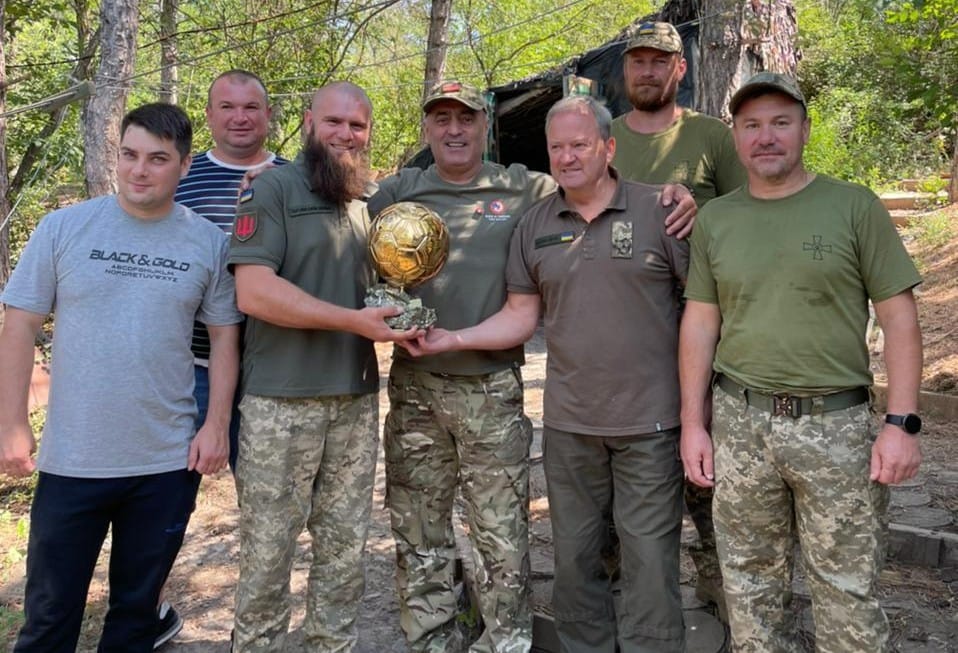
“Because of the war, you simply want to do something for your country,” Belanov says. “I visit many soldiers. I bring the Ballon d’Or with me so they can relax for a moment and smile. When you see those boys in the trenches, you understand how important even a small moment of joy can be.”
The former striker still organises weekly matches in Odesa, often featuring older players.
“There are men of 77 years old playing,” he laughs. “They completely come alive when they score. That’s the beauty of football. It gives people energy and joy.”
Chernobyl and the 1986 World Cup
On 27 April 1986, Belanov was still playing for Dynamo Kyiv against Spartak Moscow, just one day after the explosion at the Chernobyl nuclear power plant. At the time, the players knew nothing about it.
“We only found out once we had already arrived in France (for the European Cup Winners’ Cup final, ed.),” he explains. “At that moment you realise that a huge tragedy had happened in Ukraine. That gave us extra motivation to win for our country.”
A few days later, Dynamo Kyiv won the European Cup Winners’ Cup final against Atlético Madrid in Lyon. The Soviet squad then almost immediately travelled to the World Cup in Mexico.
“We had no time to rest,” Belanov says. “And in Mexico it was incredible—forty degrees. We were constantly pressing, but in the end we may have overestimated our strength.”
Belanov remains convinced that the Soviet team was stronger than Belgium in the legendary round of 16, which Belgium won 4–3.
“Belgium were lucky,” he says. “We were the better team. Today VAR would have judged some decisions differently.” Still, he speaks with great respect about the Belgian side of that time. “They eventually reached the semi-finals. That was a strong generation.”
After the match, during the doping control, Belanov also spoke with Jean-Marie Pfaff. The two players met again later on, and Belanov recalls those moments warmly.
When the conversation turns to the professional structures of top-level football in the 1980s, Belanov laughs.
“Today teams have dozens of specialists. We didn’t have any of that. No analysts, no large staff. Besides Lobanovsky, there were maybe two people.”
According to Belanov, Valeriy Lobanovsky was far ahead of his time.
“He was our analyst, our psychologist, everything at once. We had enormous respect for him. Today I rarely see coaches of that level.”
“Everyone in that team deserved the Ballon d’Or”
In 1986, Belanov also won the Ballon d’Or, which at the time could only be awarded to European players. The official ceremony took place at the Olympic Stadium in Kyiv, in front of nearly one hundred thousand supporters.
“I already knew a month in advance,” he says. “But I never saw myself as bigger than the team. That team was one unit.”
That Ukraine produced three Ballon d’Or winners—Blokhin, Belanov, and Shevchenko—is, according to him, no coincidence.
“That came from Lobanovsky, from discipline, from collective football. Of course we had talent, but above all character.”
Working with veterans and amputee football players
Today, Belanov draws most of his energy from working with veterans, children, and wounded soldiers. He travels constantly across Ukraine and is also involved in projects around amputee football.
“When people tell me I must be tired after an event with two thousand children, I feel exactly the opposite,” he says. “They give me energy. That’s when I feel I am still needed. I don’t want to just appear and disappear. I want to take time for people. I give them a part of my soul.”


